The 'Dress Your Age' Rule Is Outdated — Here's What Actually Matters Instead
Quick Answer: Fit, context (where you’re wearing it), and personal confidence are the three factors that actually determine whether an outfit works — age itself has surprisingly little predictive power once those three things are accounted for.
The ‘dress your age’ rule assumes style should narrow as you get older, but the more useful frame is that style should get more specific, not more restrictive.
Where did the ‘dress your age’ rule even come from?
It traces back to older fashion etiquette traditions that assigned specific, narrowing wardrobes to different life stages — a framework built more around social expectation than actual style principles like proportion, color, or fit.
That framework has been publicly challenged by stylists and style icons across decades who’ve shown that trend pieces, bold color, and statement silhouettes work at any age when styled with intention.
If not age, what should actually guide styling decisions?
Fit is the biggest factor — a well-fitted trend piece reads as intentional at any age, while a poorly fitted ‘age-appropriate’ piece can look just as off.
Context matters too: an outfit perfectly suited for a night out might not suit a work presentation, but that’s a context judgment, not an age judgment — the same logic applies whether you’re 25 or 65.
Are there any pieces that genuinely don’t work as people get older?
Rather than specific pieces being off-limits, it’s more useful to think about proportion and fabric choices evolving with personal comfort and taste over time — many people naturally gravitate toward certain adjustments, but that’s a preference shift, not a rule.
The pieces people are told to ‘age out of’ — mini skirts, bold prints, crop tops — are worn confidently by people across a wide age range when the fit and styling context are right.
Myth vs Fact: Dressing By Age
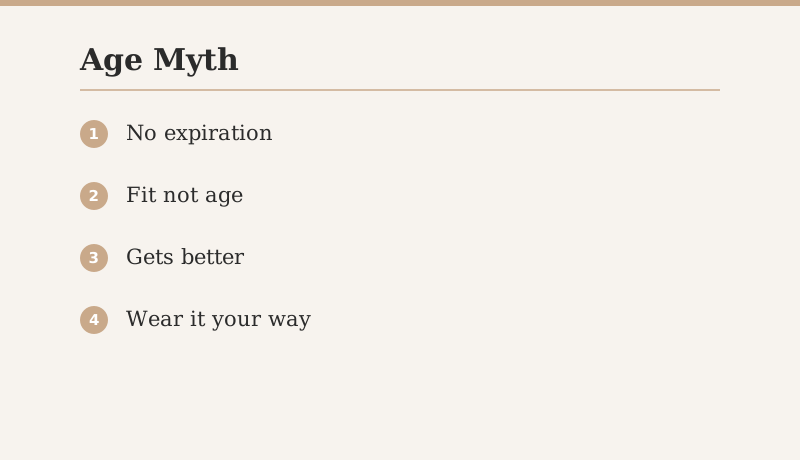
Myth: Trend pieces are only for younger people. Fact: trends can be adapted through fit, proportion, and pairing choices rather than avoided altogether — a trend piece styled thoughtfully works at any life stage.
Myth: Bold color and print get ‘too much’ as you age. Fact: confidence in bold choices often increases with age and self-knowledge — many people report feeling freer to experiment with color and print later in life, not more restricted.
How do I build confidence trying styles I’ve been told to ‘age out of’?
Start with one piece rather than a full head-to-toe trend look — a bold-colored blazer or a statement earring is a lower-commitment way to test a style direction before going further.
Paying attention to how a piece makes you feel, rather than anticipating judgment that may not even materialize, is often the actual barrier worth addressing rather than the clothing itself.
FAQ: Dressing By Age Questions, Answered
Should style change at all as people get older, or stay exactly the same?
Style often evolves naturally with changing taste, lifestyle, and comfort preferences — but that evolution should be personally driven, not dictated by an external ‘appropriate for your age’ framework.
Are there style icons known for defying age-based dressing rules?
Yes, many prominent style figures across decades have been publicly celebrated specifically for wearing bold, trend-forward pieces well into later decades of life, helping shift public perception on this rule.
Does workplace dress code count as an ‘age’ rule?
No — workplace dress codes are a context-based consideration that applies to everyone in that environment regardless of age, which is a different category from a personal styling ‘rule.’
TL;DR:
- Fit, context, and confidence determine whether an outfit works — not age
- The ‘dress your age’ rule stems from outdated social convention, not real style principles
- Trend pieces can be adapted through styling rather than avoided entirely
- Starting with one bold piece is a low-commitment way to test a new style direction
The real question was never ‘is this age-appropriate’ — it’s whether the fit is right and the context makes sense, and that calculation looks the same at every age.
Keep Reading
This article is for general styling and informational purposes only. Trends, sizing, availability and pricing may vary by brand and season.