Ageless Style

Style has no expiration date

Style Lessons From Women Who Never Aged Out of Fashion

2026-07-14

Quick Answer: Women who stay style references for decades run on five learnable principles, not on youth: a chosen signature they repeat, ruthless fit (the alterations budget is the style budget), uniform dressing that removes noise, one or two constant grooming anchors, and the self-possession to stop asking permission. Steal the framework and fill it with yourself.

Some women remain style references at every age — not by chasing youth, but by mastering principles that don’t expire.

The reassuring part: their secrets are surprisingly learnable, and none of them require a particular body, budget or decade of birth.

Style Lessons From Women Who Never Aged Out of Fashion

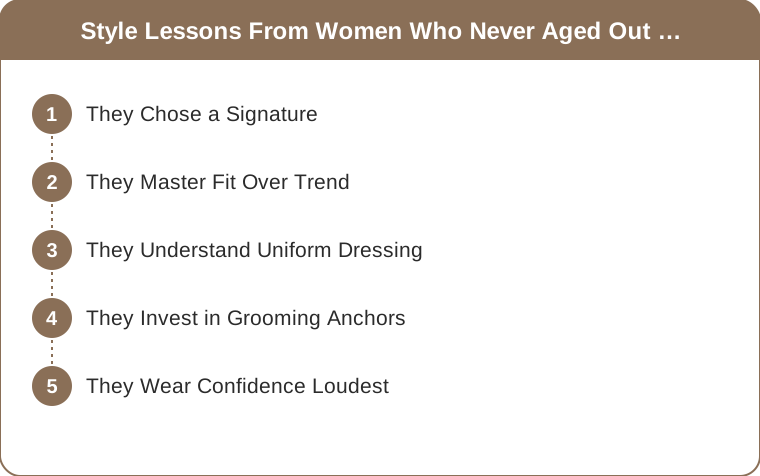
At a glance

Why do some women stay stylish at every age?

Because they built a system rather than a wardrobe.

A wardrobe is a collection of purchases and it goes out of date. A system is a set of rules about silhouette, color, fit and repetition — and rules adapt. When the trousers change shape, a woman with a system buys the new shape in her color, in her fit, and looks exactly as much herself as she did before.

The women who “age out” of fashion usually didn’t have a system. They had a decade they liked, and when it ended, nothing underneath it told them what to do next.

That’s the whole difference, and it’s entirely constructible.

What does it mean to have a signature?

Icons repeat themselves. Consistent silhouettes, a signature color, an identifiable her-ness that you could sketch from memory.

Repetition reads as identity, not as boredom. Nobody has ever looked at a woman in her fourth similar navy trouser and thought she’d run out of ideas — they thought that’s her thing.

How to find yours, practically:

  1. Scroll back through photos of yourself from the last two years and find the ten where you felt best. Not the most flattering — the ones where you felt most like yourself.
  2. Look for what repeats. A neckline, a proportion, a color family, a level of structure.
  3. Name it in one sentence. “High-waisted, neutral, one interesting texture.” “Column shapes in warm tones.” “Always a collar.”
  4. Then buy toward it deliberately instead of buying whatever’s appealing on a given Tuesday.

Decide what you’re known for and own it shamelessly. The shamelessness is not optional — a signature worn apologetically reads as a rut.

Why does fit matter more than trend?

Because every era’s icons share it, and almost nothing else.

Look across decades of style references and the clothes vary enormously. What doesn’t vary is that the clothes meet the body precisely: shoulders sitting where shoulders are, sleeves ending where they should, waists at the actual waist, hems at a deliberate point.

Trends visit their wardrobes. Fit lives there.

The practical version: the alterations budget is the style budget. A $60 shirt tailored for $25 outperforms a $300 shirt off the rack, every time, in every photo.

The four alterations worth doing almost always: hem length on trousers and skirts, sleeve length, taking in the waist on anything that gaps, and shoulder adjustment on jackets — the last is the most expensive and the most transformative.

Style Lessons From Women Who Never Aged Out of Fashion

What is uniform dressing and why does it work?

The white-shirt-and-trousers women. The all-black women. The crisp-suit women. Every one of them arrived at a formula and then stopped renegotiating it every morning.

Uniforms remove noise and amplify presence. When the clothes are consistent, people look at the person. When the clothes change dramatically every day, the clothes are the message.

A formula repeated with quality never bores. It liberates.

How to build one: pick a bottom shape that works on you, a top shape that works with it, and a third piece. Buy those three in two or three colors that all combine. That’s roughly nine outfits from six items, and none of them require a decision at 7:40am.

The practical range matters too — a uniform that only works for the office isn’t a uniform. Most durable versions have a relaxed sibling: the same proportions in softer fabric, so a high waist bootcut yoga pant with a fine knit and a blazer reads as the same woman on a Saturday as the tailored trouser does on a Tuesday.

What are grooming anchors?

One or two constants that carry entire looks: signature glasses, a committed hair philosophy, nails always done, a fragrance people associate with you.

The logic is efficiency. Polish concentrated where it counts means you can wear a simple outfit and still look finished, because the anchor is doing the work.

These also weather every fashion cycle. Hair and eyewear aren’t seasonal. A woman with excellent hair and great glasses looks pulled together in a plain sweater, which is precisely the point.

Pick one or two, not five. The anchor works because it’s consistent and maintained, and five things maintained perfectly is a full-time job.

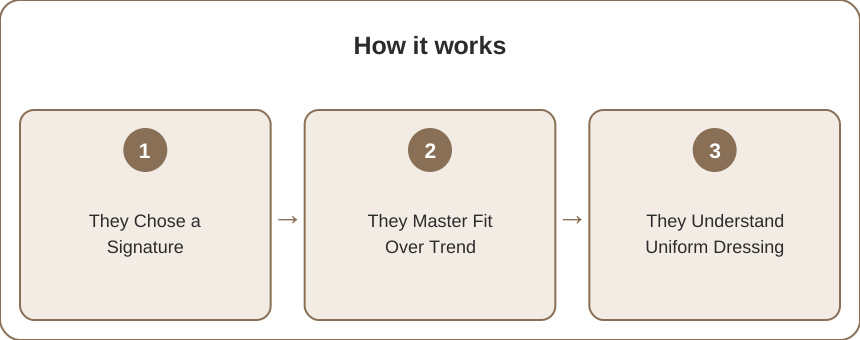
How it works

Myth vs Fact

Myth: There are things you shouldn’t wear after a certain age. Fact: There are things that don’t suit your proportions, your coloring or your life. Those categories have never mapped onto birthdays, and the rules that claim they do change every decade anyway.

Myth: Ageless style means dressing younger. Fact: It means dressing specifically. The women who read as ageless are usually the most decided-looking people in the room, not the most youthful.

Myth: It requires money. Fact: It requires editing and tailoring. A six-item uniform in well-fitting basics beats a full closet of unedited purchases, and it costs less.

Myth: A signature is limiting. Fact: A signature is a filter. It rules out roughly 90% of shopping decisions instantly, which is why women who have one shop less and wear more of what they own.

Myth: Confidence comes after the right outfit. Fact: It’s mostly the other way around. The posture of having decided is what makes an outfit look intentional — which is why the same dress reads differently on two people.

How much of it is just confidence?

More than anyone selling clothes wants to admit.

They stopped asking permission decades ago. Clothes serve them, not committees. That self-possession is the actual icon ingredient, and it’s the one thing on this list that costs nothing.

The practical version, since “be confident” is useless advice: decide the outfit before you leave the bedroom and then stop relitigating it. No mirror checks in shop windows, no pre-emptive explaining, no changing at the door. A simple outfit worn as a closed decision outperforms a complicated one worn tentatively — every single time.

FAQ

How do I find my personal style signature?

Look at photos from the last two years, pick the ten where you felt most like yourself, and find what repeats — a neckline, a proportion, a color family. Name it in one sentence and buy toward it.

Is uniform dressing boring?

Not to anyone but you, and usually not even then. Consistency reads as identity from the outside; the boredom people fear is almost always about the decision-making being boring, which is exactly what the uniform removes.

What alterations are worth the money?

Trouser and skirt hems, sleeve length, taking in a gaping waist, and jacket shoulders. The shoulder is the most expensive and the most transformative — nothing else changes how a jacket reads as much.

TL;DR:

  • Icons run a system, not a wardrobe. Systems adapt; wardrobes expire.
  • Choose a signature and repeat it shamelessly. Repetition reads as identity.
  • The alterations budget is the style budget. Fit beats price and beats trend.
  • Uniform dressing removes noise and amplifies presence — six items, nine outfits, zero morning decisions.
  • One or two grooming anchors, and the posture of having already decided. That last part is free.

Keep Reading

This article is for general styling and informational purposes only. Trends, sizing, availability and pricing may vary by brand and season.

style iconsagelesslessons

← All articles